In the 2026 Arlington residential landscape, a retaining wall is a critical structural asset designed to mitigate the challenges posed by the region’s unique topography and highly expansive clay soils. For many homeowners in North Texas, the primary goal of an installation is to create usable flat land or to protect the residential building envelope from soil erosion and hydrostatic pressure. However, a retaining wall is not merely a decorative garden feature; it is a load-bearing engineered system that must withstand immense lateral forces. Failure to account for the specific geophysics of the Arlington area can lead to structural instability and legal liability. This guide provides a comprehensive technical overview of the installation process, focusing on material selection, drainage engineering, and the regulatory requirements for high-performance structural barriers in North Texas. At Modern Build Solutions, we prioritize high-performance engineering to ensure every structure provides long-term stability for your property.
Understanding Arlington Soil Mechanics and Foundation Requirements
The foundation of a successful retaining wall in Arlington begins with an analysis of the local soil profile. North Texas is known for its high-plasticity clay, which expands significantly when wet and contracts when dry. Technically, this movement can exert thousands of pounds of pressure against a wall’s foundation, leading to heaving or settlement. To counteract this, a professional installation requires a trench excavated to a depth that reaches stable, undisturbed soil. We typically install a leveled base of compacted crushed stone or a reinforced concrete footer, depending on the wall’s height and the calculated soil load. This base serves as a flexible yet firm platform that allows the wall to settle evenly without cracking or tilting.
- Subgrade Compaction Standards: We utilize vibratory plate compactors to ensure the soil beneath the base is dense enough to support the vertical weight of the wall without subsidence.
- Embedment Depth Calculation: Technically, for every three feet of wall height, at least six inches of the first course should be buried below the finished grade to prevent the base from kicking out.
- Geotechnical Load Assessment: Our engineers calculate the active earth pressure based on the slope of the land behind the wall to determine the necessary thickness and reinforcement of the footer.
Pro-Tip: Always avoid using dirt or sand as your base material in Arlington. Technically, these materials will wash away or shift during our heavy seasonal rains, leading to a total structural failure. A minimum of six inches of compacted 57-stone (crushed limestone) is the professional standard for a stable engineered site preparation. For a technical site evaluation, you can visit our regional Arlington service portal to connect with our local specialists.
The Engineering of Hydrostatic Pressure Relief Systems
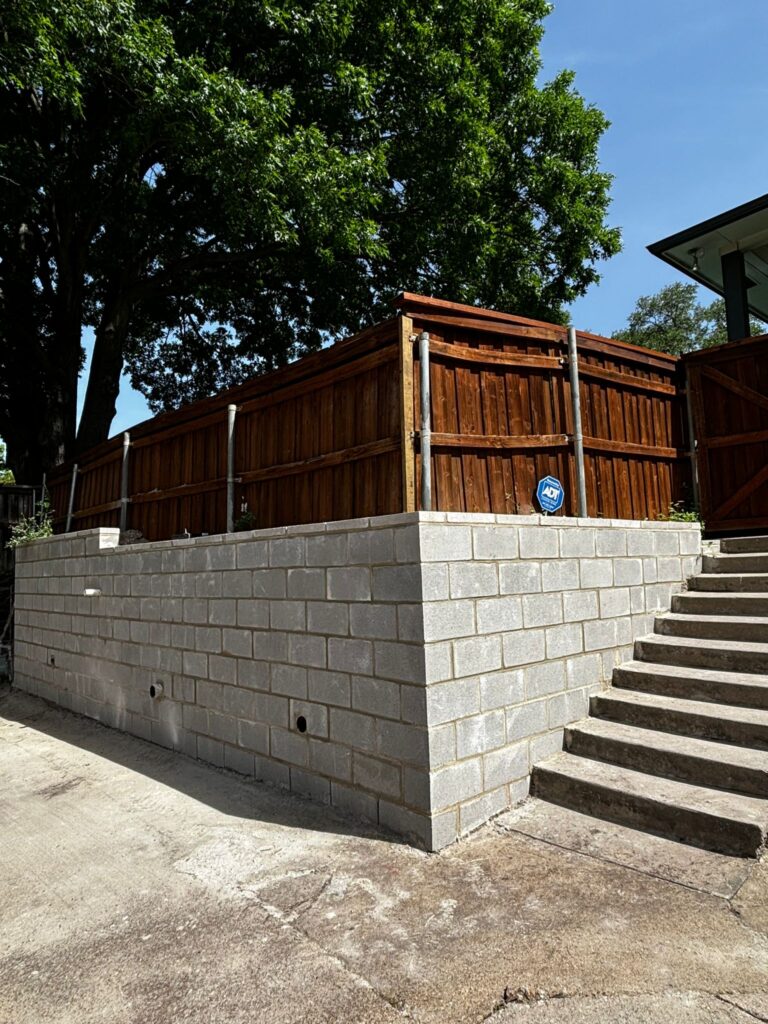
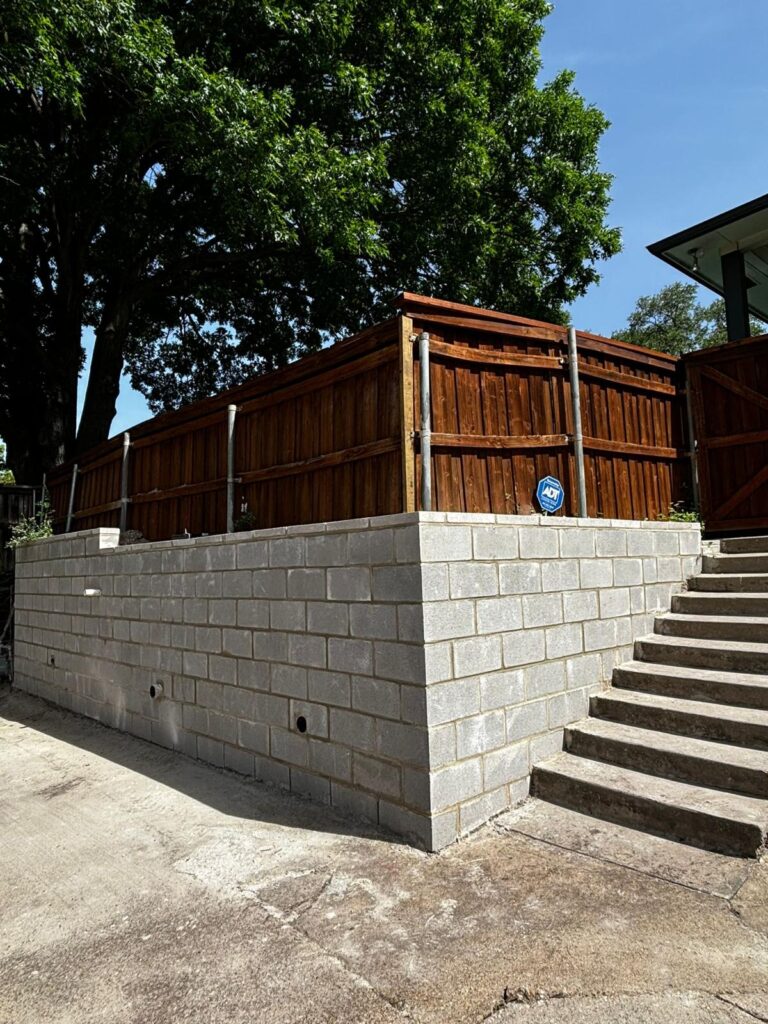
Water management is the most critical technical component of a retaining wall. More walls fail due to water pressure than soil weight. In Arlington, heavy downpours can quickly saturate the backfill, creating hydrostatic pressure that pushes against the back of the wall face. To manage this, we install a multi-layered drainage system. This includes a perforated PVC drain pipe (weep tile) at the base, covered by at least 12 inches of clean, angular gravel. This gravel chimney allows water to fall vertically to the pipe, where it is then diverted through weep holes to the front of the wall. Without this system, the wall acts as a dam, eventually leading to bowing or a catastrophic blowout.
- Filter Fabric Integration: We wrap the gravel drainage chimney in a non-woven geotextile fabric to prevent fine clay particles from clogging the drain pipe over time.
- Weep Hole Frequency: Technically, weep holes should be placed every 4 to 6 feet along the base of the wall to ensure rapid hydraulic relief during peak rain events.
- Surface Swale Calibration: We often grade the soil at the top of the wall into a shallow swale to divert surface runoff away from the wall’s backfill area entirely.
Pro-Tip: If you are building a wall on a slope, ensure your drain pipe is sloped at a minimum of 2 percent toward its exit point. Technically, water needs a clear, gravity-fed path to move away from the structure. If the pipe is level, water will pool and saturate the base, softening the soil and compromising the wall’s foundation. You can find more drainage solutions on our comprehensive structural portfolio.
Material Selection and Structural Reinforcement Techniques
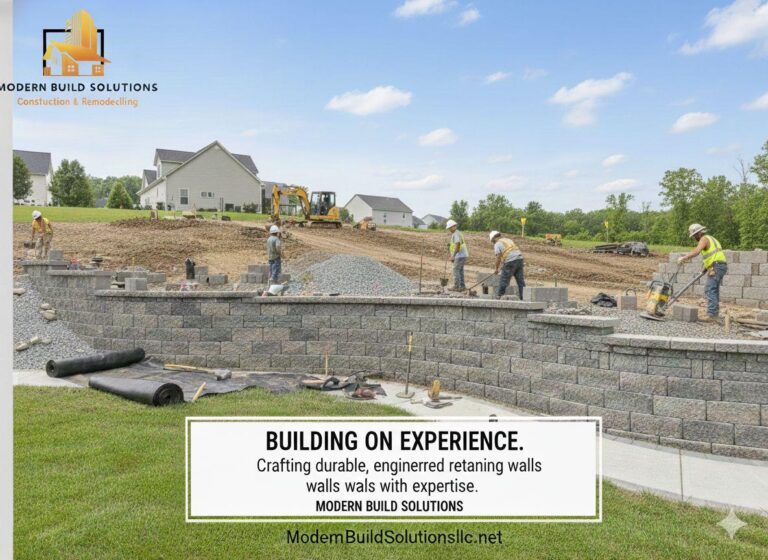
Choosing the right material for an Arlington retaining wall involves balancing aesthetic goals with mechanical requirements. Segmental Retaining Wall (SRW) blocks are a popular choice in 2026 because they are mortarless and allow for slight movement without cracking. For walls over three feet in height, we utilize geogrid, which is a high-tensile synthetic mesh buried into the backfill and pinned between the blocks. Technically, geogrid turns the soil behind the wall into a reinforced mass, using the weight of the earth to hold the wall in place. For higher-load applications, reinforced poured concrete or CMU (concrete masonry unit) walls with integrated rebar offer the highest level of structural rigidity.
- Geogrid Length Requirements: As a technical rule of thumb, geogrid should extend back into the soil at least 60 to 100 percent of the wall’s total height.
- Batter Angle Optimization: We install walls with a slight batter or inward lean of 1 inch for every foot of height to improve the structure’s resistance to overturning.
- CMU Grouting Protocols: For masonry walls, we ensure that every cell containing rebar is fully grouted with high-strength concrete to create a monolithic structural unit.
Pro-Tip: When using geogrid, ensure that the soil is compacted in thin lifts of 6 to 8 inches. Technically, if the soil is not properly compacted over the grid, the reinforcement cannot engage with the soil particles, rendering the grid useless for stabilizing the lateral load. Our structural engineering team ensures every layer meets strict density requirements.
Navigating Arlington Building Codes and Permit Requirements
In the City of Arlington, retaining wall installation is strictly governed by local building codes to ensure public safety. In 2026, any wall that exceeds four feet in height (measured from the bottom of the footer to the top of the wall) technically requires a building permit and an engineered design plan. This plan must be stamped by a licensed professional engineer to verify that the wall can handle the specific soil loads and drainage requirements of the site. Furthermore, walls that support a surcharge, such as a driveway, a swimming pool, or a neighboring structure, require permitting regardless of their height. At Modern Build Solutions, we handle the technical documentation and permitting process to ensure your project is fully compliant with local law.
Pro-Tip: Never skip the permitting process for walls adjacent to property lines. Technically, a failing wall that affects a neighbor’s property can result in massive legal liabilities and mandatory removal costs. By securing an officially permitted structural design, you protect your property rights and ensure the wall meets 2026 safety standards.
The Strategic Importance of Professional Post-Installation Inspection
Once the installation is complete, a final technical inspection is required to ensure the system is operating as designed. This involves verifying that the backfill is properly compacted in lifts and that the drainage outlets are clear of debris. In the months following the installation, we monitor the wall for any signs of settlement or lateral movement. In 2026, a professionally installed and documented wall adds significant value to an Arlington property, providing a certified structural solution that reassures future buyers and home inspectors. For more information on our commitment to quality, please visit our company heritage and mission profile.
Pro-Tip: After a major Texas rainstorm, check your weep holes. If you see water flowing out, the system is technically working. If the area in front of the wall is dry but the wall is weeping through the blocks, your internal drainage is likely clogged. Promptly scheduling a structural maintenance audit can prevent a full wall collapse.
Conclusion
A successful retaining wall installation in Arlington, TX, is a complex engineering task that requires a deep understanding of soil mechanics, hydraulic pressure, and structural reinforcement. By following a disciplined approach to foundation preparation and drainage management and material selection, you can create a barrier that is as durable as it is functional. In 2026, the unique environmental conditions of North Texas make professional oversight more important than ever. At Modern Build Solutions, we are dedicated to providing the technical expertise and high-quality craftsmanship needed to secure your landscape and protect your home’s building envelope. Do not settle for a simple stack of stones; invest in a high-performance engineered wall that will stand the test of time.
Transforming your home’s exterior stability begins with professional expertise. To learn more about the latest building standards and structural innovations in North Texas, you can access our library of technical construction insights for local inspiration. If your residence is ready for a professional and highly technical structural assessment, securing expert consultation and a formal project estimate is the most effective way to ensure a high-performance experience. You can review our history of excellence and client testimonials to see how we have served homes across the Arlington region for years. At Modern Build Solutions, we offer specialized structural renovation packages and are recognized as a leading provider of remediation for failing structures in Arlington designed to meet the unique mechanical needs of Texas properties.
FAQ
How much does retaining wall installation cost in Arlington?
The cost typically ranges from $40 to $80 per square foot of wall face, depending on the material choice and the complexity of the drainage and engineering required.
Do I need a permit for a 3-foot wall in Arlington?
Usually, no, unless the wall is supporting a surcharge like a driveway. However, technically, any wall over 4 feet requires a permit and an engineered plan.
What is the best material for a retaining wall in Texas?
Segmental concrete blocks are technically the best choice for Arlington because they are durable and can accommodate the natural expansion of clay soils.
How long does it take to install a retaining wall?
A standard residential project usually takes between 3 and 7 days, depending on the site accessibility and the amount of excavation required.
Why did my previous retaining wall fail?
Most failures in Arlington are technically caused by poor drainage or a shallow foundation that could not withstand the local hydrostatic pressure and clay movement.
Can I build a retaining wall myself?
Small garden walls under 2 feet are possible for DIYers, but any structural wall should be handled by a professional to ensure it meets safety and engineering codes.
Does your company provide commercial installation?
Yes. We provide industrial-scale earth retention solutions for both residential and commercial properties throughout the North Texas region.
What is geogrid, and do I need it?
Geogrid is a technical reinforcement mesh. You technically need it if your wall is over 3 feet tall or if it is holding back a significant slope or heavy load.
How do I know if my wall needs repair?
Look for leaning, bowing, or large cracks. These are technical indicators of structural stress. Visit our stabilization and restoration guide for more details.
Will a retaining wall help with yard drainage?
Yes. A properly engineered wall includes a drainage system that collects and diverts water, technically improving the overall moisture management of your landscape.